
Nonprofit Salary Impact Calculator
How much additional funding would your nonprofit need to pay staff fair wages? This calculator shows how donor decisions impact staff sustainability based on 2025 nonprofit salary data.
Your Results
Enter your budget details to see your staffing impact analysis
Ever wonder why the person running a food bank, organizing homeless shelters, or leading a youth mentorship program makes barely more than minimum wage? You’re not alone. Nonprofit workers often pour their hearts into causes that change lives-yet their paychecks tell a different story. Why do nonprofits not pay well? It’s not because they don’t value their staff. It’s because of a system built on assumptions, donor expectations, and structural limits.
Donors Expect Every Dollar to Go to the Cause
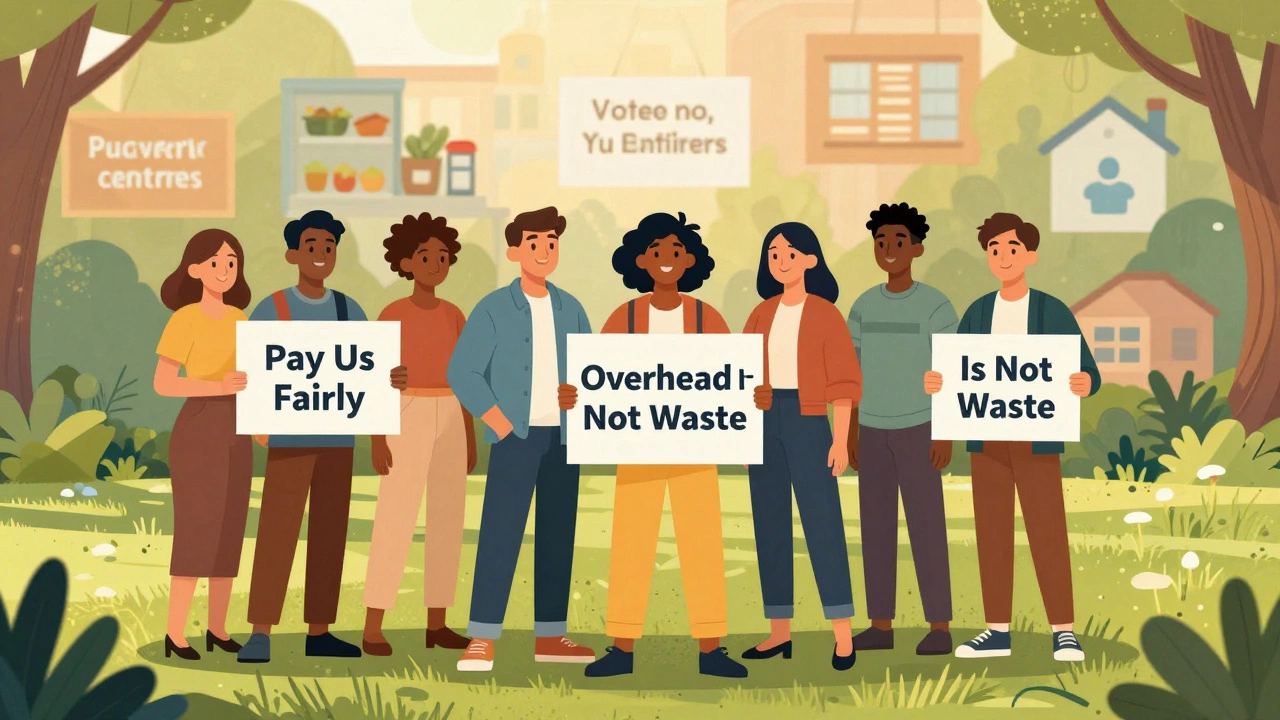
Most people who give to charities believe their money should go straight to helping people-not to paying salaries. That’s a well-meaning idea, but it’s also dangerously misleading. When donors see a nonprofit spend $15,000 a year on a program coordinator, they think, "That’s too much. Why not hire two volunteers?" But here’s what they don’t see: without that coordinator, the program falls apart. Volunteers can’t manage budgets, track grants, or respond to emergencies on a 9-to-5 schedule.Nonprofits are stuck in a cycle where donors reward low overhead, not high impact. A charity that spends 85% on programs and 15% on admin gets praised. But a charity that spends 70% on programs and 30% on staff? That’s labeled "wasteful," even if the latter delivers twice the results. This myth keeps salaries artificially low. Executive directors at major nonprofits often earn less than middle managers at for-profit companies doing similar work.
Nonprofits Don’t Have Profit Margins
Think about how businesses work. A coffee shop makes $5 per latte. After paying rent, staff, and beans, it still has money left over. That leftover cash? It pays for raises, better equipment, or even bonuses. Nonprofits don’t have that luxury. They rely on donations, grants, and fundraising events. Every dollar has a string attached.Grants often come with strict rules: "Funds can only be used for direct services, not salaries." Donors write checks for "feeding the hungry," not for "hiring a qualified social worker." So nonprofits stretch their budgets thin. One person might handle fundraising, accounting, program delivery, and volunteer coordination-just to keep the lights on. And they’re paid $45,000 a year while working 60-hour weeks.
There’s no profit to reinvest. No stock options. No performance bonuses. No raises tied to growth. If a nonprofit expands its services, it doesn’t get richer-it just needs to fundraise harder.
Competition for Talent Is Real, But Not Fair
You’d think that people who care deeply about a cause would accept lower pay. And many do. But that creates a dangerous feedback loop. The best candidates-those with degrees, certifications, or years of experience-often leave for higher-paying jobs in government, healthcare, or even corporate social responsibility roles. The nonprofits left behind are stuck with people who can’t afford to leave, not because they’re less skilled, but because they’re more committed.A study from 2024 by the Nonprofit Professional Empowerment Project found that 68% of nonprofit employees with master’s degrees in social work or public administration had switched to for-profit jobs within five years. The reason? Pay. Benefits. Stability. One program director in Chicago told me: "I loved my job. But when my kid got sick and I couldn’t afford the deductible, I quit. I couldn’t justify working 70 hours a week to save others when I couldn’t save myself."

The "Passion Tax" Is Real
There’s a hidden cost to working in nonprofits: the expectation that you should love your job enough to work for free. This is called the "passion tax." Employers assume that because you care about homelessness, education, or climate change, you’ll tolerate low pay, no vacation, and burnout.It’s not just unfair-it’s unsustainable. Burnout rates in nonprofits are 40% higher than in the private sector, according to the 2025 National Nonprofit Workforce Survey. People leave not because they don’t care, but because they can’t keep going. And when experienced staff quit, the organization loses institutional knowledge. New hires have to relearn everything. Programs stall. Donors notice. Trust erodes.
Small Nonprofits Get Left Behind
Big charities like the Red Cross or UNICEF have donor networks, PR teams, and endowments. They can afford to pay competitive salaries. But local nonprofits? The ones feeding families in rural towns, tutoring kids after school, or helping veterans find housing? They’re the ones most likely to pay $35,000 or less.Why? Because they don’t have the brand recognition to attract big donors. They rely on small gifts from neighbors, church groups, and local businesses. Their budgets are tight. Their boards are volunteers. They can’t afford HR departments to benchmark salaries. So they guess. And they guess low.
One small nonprofit in rural Ohio pays its director $32,000 a year. She works 55 hours a week, manages 12 volunteers, and runs a food pantry that serves 800 families monthly. She’s got a master’s in public policy. She could make $75,000 at a state agency. But she stays. Because she believes in the mission. That’s noble. But it shouldn’t be the only option.
What’s Changing? Slowly
Thankfully, things are starting to shift. More donors are realizing that strong leadership = better outcomes. Foundations like the Ford Foundation and the Gates Foundation now fund "infrastructure grants"-money specifically for salaries, training, and systems.Some nonprofits are being upfront about their needs. "We need $100,000 to hire a full-time grant writer," says a nonprofit in Atlanta. "Without her, we lose $1.2 million in funding every year." That kind of honesty is rare-but growing.
Also, younger generations are pushing back. They won’t accept "I love this cause" as a substitute for a living wage. They’re asking: "What’s your salary range?" "Do you offer health insurance?" "Can I take time off?" And nonprofits that answer honestly are seeing better retention and higher-quality applicants.
It’s Not About Greed. It’s About Sustainability.
Nonprofits don’t pay well because the system is broken-not because they’re stingy. The real issue isn’t that workers want more money. It’s that society refuses to value their work at the same level as other professions.Would you expect a teacher, nurse, or firefighter to work for half the pay because they "love helping people"? Of course not. But we do it every day with nonprofit workers. That’s not charity. That’s exploitation disguised as altruism.
If you want nonprofits to do more, pay them better. Fund their staff. Support their overhead. Trust that a well-paid, stable team will do more good than a burned-out volunteer with a heart of gold.
Because here’s the truth: nonprofits don’t fail because they lack passion. They fail because they lack resources. And the biggest resource they need? Fair pay.
Do nonprofit employees ever get raises?
Raises are rare in nonprofits. Many organizations freeze salaries for years because they can’t predict funding. Some rely on one-time grants or donor gifts to give small increases. Larger nonprofits with endowments or government contracts are more likely to offer annual raises, but even then, they often lag behind inflation. The 2025 Nonprofit Salary Report showed that 61% of nonprofits hadn’t increased base pay in over three years.
Can nonprofits afford to pay more?
Yes-but only if donors change how they give. Most nonprofits already spend 80-90% of their budget on programs. The rest goes to overhead: rent, utilities, software, and staff. If donors were willing to contribute even 5-10% more toward operational costs, nonprofits could raise salaries without cutting services. The problem isn’t money-it’s perception. Donors need to understand that paying staff well isn’t a cost-it’s an investment in long-term impact.
Why don’t nonprofits use more volunteers to cut costs?
Volunteers are essential, but they can’t replace paid staff. Volunteers don’t work full-time. They can’t handle complex tasks like grant writing, legal compliance, or crisis response. A food bank might have 50 volunteers on Saturday, but only one paid manager to coordinate them, track inventory, and meet donor requirements. Without that paid staff, the whole system collapses. Volunteers help scale impact-they don’t replace the structure that makes it possible.
Are nonprofit salaries lower across the board?
Yes. According to the 2024 Nonprofit Compensation Benchmark, nonprofit workers earn 20-30% less than their counterparts in for-profit or government roles with the same education and experience. The gap is widest in leadership roles. A nonprofit executive director with 10 years of experience earns about $68,000 on average, while a corporate manager in a similar role earns $110,000. The difference isn’t about skill-it’s about how society values the work.
What can donors do to help?
Donors can start by asking: "What percentage of your budget goes to staff?" Then, if it’s above 15%, don’t assume it’s too high. Ask: "How would increasing staff pay improve your outcomes?" Many nonprofits can show clear data: higher retention = more consistent service = better results. Donors who fund overhead, not just programs, are the ones making real change. Consider giving to "capacity-building" funds or donating specifically to cover salaries.