Charitable Structure Selector
Define Your Organization
Why this fits you:
Select your options and click "Analyze Best Fit"
We will compare Charitable Trusts, Incorporated Societies, and Companies Limited by Guarantee.
Setting up a charitable trust is more than just filling out forms. It’s about building a legal vessel that carries your mission forward long after you’re gone. If you get the structure wrong, you risk losing tax benefits, facing endless administrative headaches, or worse-having your charity shut down by regulators. But if you get it right, you create a resilient engine for social good.
You don’t need to be a lawyer to understand this, but you do need to be precise. The difference between a successful trust and a failed one often comes down to how clearly you define who runs it, what it does, and how money moves through it. Let’s walk through exactly how to build that structure so it holds up under pressure.
Choosing the Right Legal Vehicle
Before you write a single word of your trust deed, which is the foundational legal document that establishes the rules and purposes of a charitable trust, you need to decide on the vehicle. In many jurisdictions, including New Zealand and parts of the UK, a charitable trust is distinct from an incorporated society or a company limited by guarantee.
A trust is ideal when you want a small group of dedicated individuals (trustees) to manage assets with flexibility. Unlike a company, it doesn’t have shareholders. Unlike a society, it doesn’t require a large membership base. This makes it perfect for family-led philanthropy or specific project funding where control needs to remain tight.
- Trust: Best for asset-heavy operations or private family giving. High flexibility, low bureaucracy.
- Incorporated Society: Best for member-driven groups like clubs or community associations.
- Company Limited by Guarantee: Best for larger organizations needing formal corporate governance and liability protection.
If your goal is to donate significant sums without ongoing public reporting requirements, the trust model usually wins. However, check local laws. In some places, trusts are harder to register as charities than companies because they lack separate legal personality.
Drafting the Trust Deed: Your Rulebook
The trust deed is your bible. It dictates everything. If it’s vague, trustees will argue. If it’s too rigid, the charity will die when circumstances change. You need a balance.
Start with the charitable purpose. This isn’t just a slogan. It must fit into recognized legal categories of charity. These typically include:
- Relief of poverty
- Advancement of education
- Advancement of religion
- Other purposes beneficial to the community (e.g., health, environmental conservation)
Be specific. Instead of saying “to help people,” say “to provide vocational training for unemployed youth in Wellington.” Vague purposes lead to rejection by tax authorities. In New Zealand, for instance, the Charities Commission looks closely at whether your purpose provides a clear public benefit, not just private gain.
Next, define the trustees, who are individuals legally responsible for managing the trust's assets and ensuring compliance with its charitable purpose. Specify how many there should be (usually three to seven), how they are appointed, and how they can be removed. Include a clause for succession planning. What happens if all original trustees retire? Without a mechanism to appoint new ones, the trust becomes orphaned and potentially frozen.
Governance Structure and Decision-Making
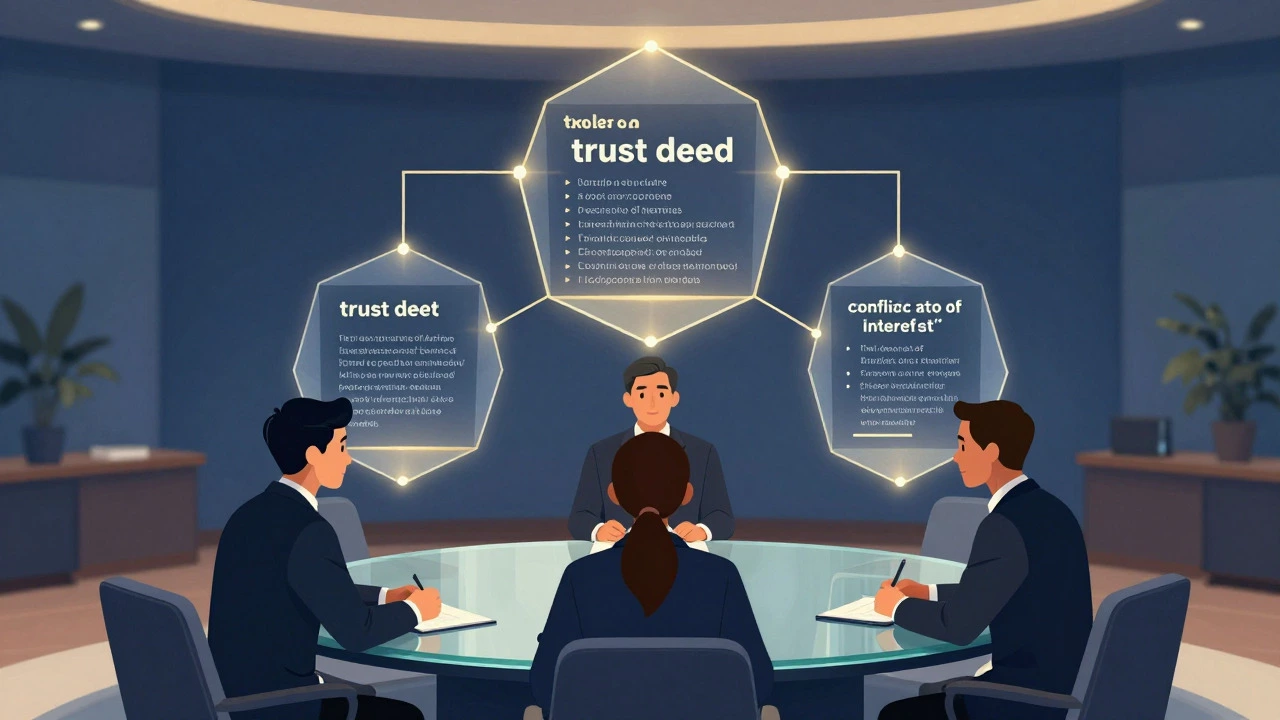
Who actually makes decisions? In a trust, power rests with the trustees. But how do they act? You need clear rules on meetings and voting.
| Element | Best Practice Recommendation | Risk if Ignored |
|---|---|---|
| Quorum | Majority of trustees (e.g., 3 out of 5) | Deadlock; inability to act during crises |
| Voting | One vote per trustee; simple majority unless specified otherwise | Disputes over authority; minority rule |
| Meetings | At least twice yearly; minutes recorded | Regulatory non-compliance; poor oversight |
| Conflicts of Interest | Mandatory declaration and recusal from voting | Fraud; loss of public trust; legal action |
Don’t skip the conflict of interest clause. It’s the number one reason charities fail audits. If a trustee’s spouse owns the accounting firm you hire, that trustee must declare it and step out of the room while the decision is made. Write this explicitly into the deed.
Financial Management and Investment Powers
Money flows in, money flows out. How you handle it defines your credibility. Your deed should grant trustees broad investment powers. Don’t restrict them to “bank accounts only” unless you have a very small fund. Modern trustees need to invest in diversified portfolios to beat inflation. Otherwise, your capital erodes, and your impact shrinks.
Specify how funds are distributed. Are distributions discretionary? Or are they mandatory? Discretionary trusts offer more flexibility, allowing trustees to respond to urgent community needs. Mandatory trusts might be better if you’re funding a specific scholarship every year.
Also, address expenses. Can trustees pay themselves? Generally, no. Trustees serve voluntarily. However, can the trust pay for professional advice (legal, accounting)? Yes, and it should. Clarify that reasonable administrative costs are deductible expenses. This prevents trustees from having to dip into their own pockets to keep the lights on.

Tax Status and Regulatory Compliance
Structure affects taxes. In most countries, charitable trusts enjoy income tax exemptions, but only if registered correctly. In New Zealand, you apply to the Charities Register. In the US, you file Form 1023 with the IRS. In the UK, you register with the Charity Commission.
The key here is public benefit. Regulators want proof that your work helps society, not just a closed group of friends. When structuring your trust, ensure your beneficiaries are defined broadly enough to satisfy this test. For example, “helping employees of Company X” is often rejected as private benefit. “Helping workers in the manufacturing sector” is accepted.
Keep records. Every transaction, every meeting minute, every donor acknowledgment. Auditors don’t care about your good intentions; they care about paper trails. Implement a basic bookkeeping system from day one. Use cloud-based software designed for nonprofits. It saves hours later.
Common Pitfalls to Avoid
I’ve seen well-meaning founders trip over simple issues. Here’s what to watch out for:
- Too few trustees: Having only two trustees means if one leaves, you’re stuck. Aim for at least three.
- Vague objectives: “To promote happiness” is not a charitable purpose. Be concrete.
- No dissolution clause: What happens if the trust fails? Specify that remaining assets go to another similar charity. This is called a “cy-près” provision. Without it, assets might revert to the state or original donors, creating legal messes.
- Ignoring digital security: Your trust holds sensitive data. Ensure your governance includes policies on data protection and cybersecurity.
Structuring a charitable trust is an investment in longevity. Take the time to get the deed right. Consult a specialist lawyer-not a generalist-to review your draft. The cost is minor compared to the decades of operation you’re aiming for.
Do I need a lawyer to set up a charitable trust?
While you can use templates, hiring a lawyer specializing in charity law is highly recommended. They ensure your trust deed meets local regulatory standards, avoids common pitfalls, and maximizes tax benefits. The upfront cost protects you from expensive legal fixes later.
Can a charitable trust make a profit?
Yes, but the profit cannot be distributed to owners or shareholders since trusts don’t have them. Any surplus must be reinvested into the trust’s charitable activities. This is known as the “non-distribution constraint.”
How many trustees should I have?
Aim for at least three trustees. This ensures continuity if one steps down and allows for diverse perspectives in decision-making. Too many trustees (over seven) can lead to inefficiency and difficulty reaching consensus.
What is the difference between a trust and a foundation?
In many jurisdictions, these terms are used interchangeably. However, technically, a foundation is often a type of charitable trust or company established with a specific endowment. The key difference lies in local legal definitions, so check your country’s charity regulator guidelines.
Can I change my charitable trust’s purpose later?
It depends on your trust deed. Most deeds allow changes if all trustees agree and the new purpose remains charitable. Some require court approval or consent from a protector. Always include a clear amendment clause in your initial deed to maintain flexibility.