Flirting Authenticity Checker
Enter your flirting scenario below. We'll check if it aligns with the article's principles of authentic connection in after-school clubs.
Flirting in a club doesn’t mean dancing too close or buying someone a drink. In after-school clubs, it’s about connection-not performance. These aren’t nightclubs with loud music and dim lights. These are places where kids show up because they care about robotics, drama, debate, or skateboarding. The goal isn’t to impress. It’s to find someone who gets you.
Start with the activity, not the person
When you’re in a club, the activity is your icebreaker. If you’re in the coding club and someone’s stuck on a Python loop, don’t just say "Hey, you’re cute." Say, "That error’s annoying-I had the same one last week. Want me to show you how I fixed it?" You’re helping. You’re being useful. And that’s way more attractive than any line.
Same goes for the drama club. If someone’s rehearsing a monologue and you notice they’re tripping over the same line, don’t wait for them to ask. Just say, "Try pausing right after ‘I can’t’-it gives it more weight." You’re not flirting. You’re being a good teammate. And that’s how real connections start.
Body language speaks louder than compliments
Forget saying "You’re hot" or "I like your shirt." In a school club, that sounds awkward. Instead, notice the small things. Do they lean in when someone’s talking? Do they laugh at the right moments? Do they remember your name after you introduced yourself three days ago?
These are the signals. If someone remembers you brought your own sketchbook to the art club last week, and now they ask, "Did you finish that drawing?"-that’s not random. That’s interest. And the best way to respond? Not with a cheesy reply. Just say, "Yeah, I added the clouds. Want to see?" Then show them. No pressure. No performance.
Don’t chase attention. Build trust
One of the biggest mistakes? Trying to be the center of attention. In after-school clubs, people notice who shows up consistently-not who tries hardest to stand out. The person who always arrives early to set up the equipment. The one who stays late to clean up the lab. The one who asks, "What do you need help with?" instead of "Do you want to hang out?"
Trust is the real currency here. If you want someone to like you, be someone they can count on. That doesn’t mean doing everything for them. It means showing up. Being reliable. Not disappearing for weeks because you got bored.
Use the space, not the spotlight
Clubs aren’t stages. They’re shared spaces. If you’re in the chess club, don’t sit across from them and stare. Sit two seats away. Play your game. Let them notice you’re there. When they make a good move, say, "Nice. That’s the same trick my uncle used." Then go back to your board. No big speech. No awkward silence.
Same with the music club. If someone’s tuning their guitar and you’re listening, don’t interrupt. Wait till they finish. Then say, "That riff sounded like the one in ‘Creep’-but slower." That’s enough. You’re showing you paid attention. That’s flirting.

Timing matters more than courage
There’s a reason you don’t ask someone out right after they lose a debate or mess up a dance routine. That’s not the moment. That’s the moment they’re already feeling vulnerable. Wait for the calm. Wait for when they’re laughing with a group, or when you’re both waiting for the kettle to boil in the club kitchen.
Ask something simple: "Are you coming to the next meeting?" or "Did you get that book from the library?" If they answer with more than one word, you’ve got a thread. Pull it gently. Don’t yank.
It’s okay if it doesn’t go anywhere
Not every connection turns into something more. And that’s fine. You’re not failing if they don’t text you back. You’re not weird if they don’t ask you to the school dance. Clubs are about shared interests-not romance.
Some people just want to learn. Some want to hang out. Some want to be left alone. And that’s okay. The goal isn’t to "get" someone. The goal is to be someone worth being around.
What to avoid
- Don’t compliment appearance. Not in a school club. It feels out of place.
- Don’t try to be funny if it’s not natural. Forced jokes make people uncomfortable.
- Don’t hover. If they walk away after you talk, don’t follow. Give space.
- Don’t use pickup lines. They’re not clever. They’re lazy.
- Don’t assume interest because they smiled once. Smiles are polite. Not promises.

Real examples from real clubs
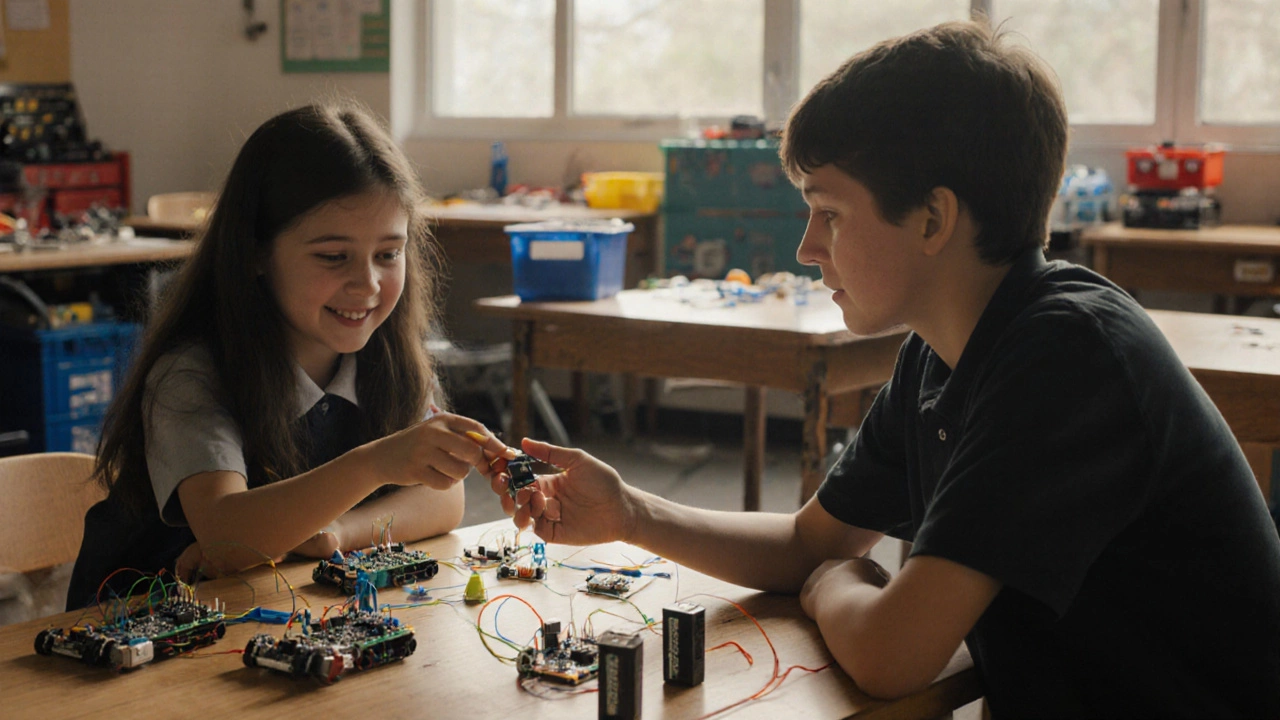
In the robotics club last term, a girl kept asking the guy next to her how he wired his sensor. He didn’t say a word about liking her. But he started saving extra batteries for her. One day, he just handed her one and said, "You’ll need this tomorrow." She smiled. That was it. No big moment. Just a battery. And now they work together every week.
In the writing group, a boy wrote a poem about rain. Someone else wrote one too. They didn’t say anything. But they started leaving their notebooks open on the same table. Week after week. Eventually, one left a sticky note: "Your last line was better." The other replied: "I stole it from you." They started reading each other’s work. Now they’re dating.
It’s not dramatic. It’s quiet. And that’s why it works.
What happens if you get rejected?
If someone doesn’t respond to your quiet signal? That’s not failure. It’s data. Maybe they’re shy. Maybe they’re not interested. Maybe they’re dealing with something else. You don’t need to know why. Just move on.
Stay in the club. Keep showing up. Keep being kind. Keep helping. That’s the real win. Because the person who shows up, day after day, doesn’t just attract romance. They attract respect. And respect lasts longer than a crush.
Final thought: Flirting is just being human
You don’t need tricks. You don’t need confidence that’s fake. You just need to be present. Listen. Notice. Care. That’s all it takes.
In after-school clubs, the best way to flirt is to be the kind of person someone wants to sit next to-even if they never say it out loud.
Is it okay to flirt in school clubs?
Yes, but it’s not about romance. It’s about connection. School clubs are safe spaces to practice social skills. Flirting here means being attentive, kind, and genuine-not performing or pressuring. If both people are comfortable and the focus stays on the activity, it’s natural and healthy.
What if I’m too shy to talk to someone?
Start small. Say hi when you see them. Ask a question about the activity. "Did you finish the circuit?" or "What song are you practicing?" You don’t need to be loud. Just be consistent. People notice quiet effort more than bold moves.
How do I know if someone likes me back?
Look for actions, not words. Do they remember your name? Do they save you a seat? Do they ask you for help? Do they stay late when you do? These are signs. If they’re just polite, they’ll keep it surface-level. If they’re interested, they’ll make space for you.
Can I ask someone out after a club meeting?
Yes-but keep it low-pressure. Say something like, "We should grab coffee after the next robotics meet." Not "Want to go on a date?" No big announcement. No audience. Just a simple invitation. If they say yes, great. If they say no, thank them and move on. No drama.
What if the club rules say no dating?
Some clubs don’t allow romantic relationships during meetings. That’s fine. Respect it. But that doesn’t mean you can’t build a friendship that grows outside. Focus on the activity first. Let the connection develop naturally. If it turns into something more later, that’s okay-as long as it doesn’t disrupt the group.