
Charity Impact Calculator
See how much of your donation actually reaches the cause. Enter your donation amount and the charity's spending percentages to see the real impact.
Your Donation Impact
When you donate to a charity - whether it’s a bake sale, a marathon fundraiser, or a simple online gift - you want to believe your money is helping people. But how much of it actually gets there? The question isn’t as simple as it sounds. Too many charities claim 90% of donations go to the cause, but the truth is messier. Some give more than 90%. Others give less than 50%. And what even counts as "going to the cause"? That’s what most people don’t realize.
What counts as "giving"?
Not all charity spending is created equal. When you hear "85% of donations go to programs," that sounds great. But what does "programs" mean? It could mean food packs, school supplies, or clean water pumps. Or it could mean a paid fundraiser handing out flyers. The line between "direct aid" and "fundraising" is blurry, and not every charity defines it the same way.
Take the case of a local food bank. If they spend $10,000 on refrigerated trucks to deliver meals, is that overhead? Or is it part of the service? If they hire a part-time coordinator to manage volunteers, is that administrative? Or is it essential to keeping the food flowing? The IRS and charity watchdogs classify these differently, and the labels don’t always match reality.
Here’s the standard breakdown you’ll see on most charity websites:
- Program expenses: Direct services - food, shelter, education, medical care
- Fundraising expenses: Costs to raise money - ads, events, donor mailings
- Administrative expenses: Rent, salaries, accounting, insurance
But here’s what they don’t tell you: some charities count event tickets as "revenue," not "cost." So if you pay $50 for a charity dinner, that $50 gets counted as money raised - even if $40 of it was spent on the meal. That makes the charity look more efficient than it is.
Real numbers from real charities
Let’s look at actual data from 2025 reports filed with the New Zealand Charities Register and U.S. IRS Form 990. These aren’t estimates - they’re audited financials.
A large international aid group like Save the Children spent 79% on programs in 2025. That sounds good - until you see their fundraising costs were 18%. That means for every $100 donated, $18 went to asking for more money. And $3 went to admin. So yes, 79% went to programs. But it took $21 to get that $79.
Compare that to a small community food pantry in Wellington. In 2025, they spent 94% on food and direct aid. Fundraising? $1,200 total - mostly from local church groups. Admin? One part-time coordinator paid $25,000 a year. That’s 6% of their budget. So for every $100 donated, $94 went straight to meals. No billboards. No telemarketers. Just people showing up.
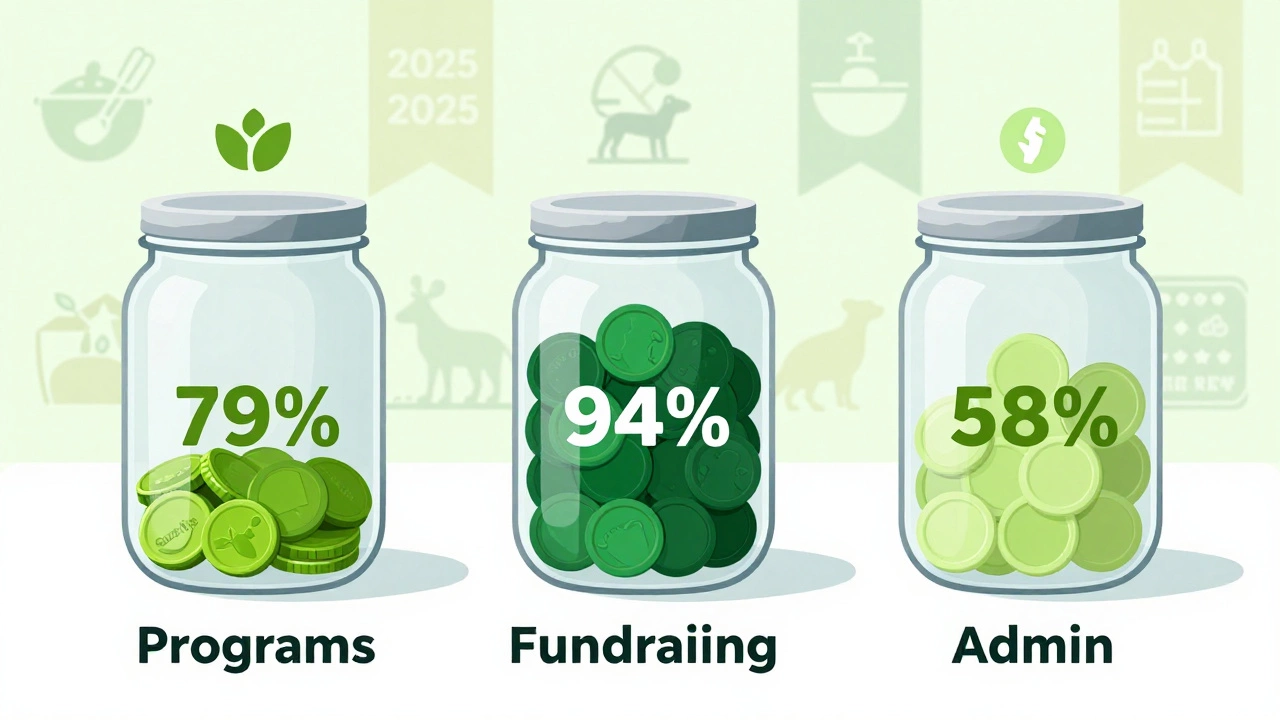
Here’s a quick comparison of three real charities from 2025:
| Charity | Program Spending | Fundraising Costs | Admin Costs | Net Impact per $100 Donated |
|---|---|---|---|---|
| Save the Children (global) | 79% | 18% | 3% | $79 in aid |
| Wellington Food Pantry | 94% | 2% | 4% | $94 in aid |
| Global Animal Rescue Org | 58% | 35% | 7% | $58 in aid |
Notice the gap? The global animal rescue org spends 35% just to ask for money. That’s not unusual. Many national charities run expensive TV campaigns or hire for-profit fundraising firms that take 40-60% of what they collect. You give $100. The firm takes $50. The charity gets $50. Then they spend $20 of that on more ads. So only $30 reaches the animals.
Why do some charities spend so much on fundraising?
It’s not always greed. Some charities need to grow fast. If you’re trying to end homelessness in a city of 500,000, you can’t wait for word-of-mouth. You need billboards, radio spots, and direct mail. That costs money. But here’s the catch: many charities keep fundraising at high levels even after they’ve hit their goals. They don’t scale back because donors keep giving - and the staff who run those campaigns still need jobs.
There’s also the "charity arms race." If one group spends $1 million on a TV ad and raises $10 million, others feel pressured to do the same. It becomes a cycle: spend more to raise more, then spend more again to keep raising. And the people who benefit? They don’t see the increase.
Smaller, local charities rarely do this. They rely on trust, not ads. A church group holding a pancake breakfast doesn’t need a marketing team. A school raising money for new books doesn’t need a PR firm. They just ask their community. And because they don’t have to pay for expensive campaigns, they can give more.
How to find the charities that give the most
You don’t need to be a financial expert to know where your money goes. Here’s how to check in three minutes:
- Look up the charity on a watchdog site. In New Zealand, use Charities Services (www.charities.govt.nz). In the U.S., use Charity Navigator or GuideStar. They publish audited financials.
- Check the program percentage. Aim for 75% or higher. Anything below 65% should raise a red flag - unless it’s a new charity or a very complex cause like research.
- Read the fundraising line. If fundraising costs are more than 15% of total spending, ask why. Is it because they’re trying to expand? Or because they’re stuck in a cycle of expensive campaigns?
- Look for recurring donors. If 60% of their income comes from monthly donors, they’re likely not spending heavily on one-time fundraising. That’s a good sign.
- Ask for their latest annual report. Most charities will email it to you. Read the "Statement of Financial Activities." It’s not marketing - it’s real numbers.
One thing to watch out for: charities that say "100% of your donation goes to the cause" - unless they’re funded by a wealthy donor who covers all overhead. If they’re asking you to pay for their rent, staff, and ads, then no, not all of it goes to the cause. That’s misleading.

What about charity events?
Walkathons, galas, raffles - they’re fun. But they’re also expensive. A charity gala might raise $50,000. But if they spent $30,000 on the venue, catering, and band, that’s a 60% cost-to-revenue ratio. That means for every dollar raised, 60 cents disappeared into the event. The rest? Half of that might go to admin. So maybe only $10,000 actually helped people.
Compare that to a simple online donation page. No venue. No food. No DJs. Just a secure form. The cost? Maybe $100 in credit card fees. That’s 0.2% overhead. The same $50,000 raised online might mean $49,900 goes to aid.
That’s why many local groups are moving away from events. They’re asking for direct donations instead. And the people they help? They get more.
Don’t stop giving - just give smarter
It’s easy to feel discouraged. If 30% of your donation vanishes, why bother? But here’s the truth: even if a charity spends 40% on fundraising, it might still be doing vital work. A global health nonprofit might raise money from 20 countries. Without those campaigns, they wouldn’t reach anyone. So sometimes, high costs are necessary.
The goal isn’t to avoid charities. It’s to support ones that match your values. If you care about local hunger, give to the food pantry that spends 94% on meals. If you care about global disease prevention, and the charity has a track record of saving lives, then even 70% program spending might be worth it.
And if you really want to maximize your impact? Consider donating monthly. One $20/month gift is more stable than a one-time $240 donation. It lets charities plan. It cuts their fundraising costs. And over time, it saves them tens of thousands in marketing.
Charities aren’t all the same. Some are efficient. Some are wasteful. Some are honest. Some are hiding numbers. But the data is out there. You just have to look.
Do charities have to disclose how they spend money?
Yes, in most countries, registered charities must file annual financial reports. In New Zealand, all charities above a certain income must submit their statements to the Charities Services register. In the U.S., nonprofits file Form 990 publicly. These documents show exactly how much they spent on programs, fundraising, and admin. You can find them online - no login needed.
Is it better to donate to small local charities or big national ones?
It depends on what you want to achieve. Small local charities often give 90%+ of donations directly to services. Big national ones may spend more on fundraising and admin, but they can reach more people, scale faster, and fund complex projects like disaster relief or research. If you want to help your neighborhood, go local. If you want to tackle a global issue, a larger org might be more effective. The best approach is often both.
What’s a reasonable fundraising cost for a charity?
There’s no universal rule, but 10-15% is generally considered efficient. Below 10% is excellent. Above 20% should prompt questions. Some charities - especially those launching new programs or working in hard-to-reach areas - may temporarily spend more. But if a charity consistently spends over 25% on fundraising for years, it’s worth investigating why.
Can I ask a charity for their financial report?
Absolutely. Any reputable charity will happily send you their latest annual report or financial statement. In fact, many post them online. If a charity refuses or makes it hard to find, that’s a red flag. Transparency isn’t optional - it’s a sign of trustworthiness.
Are charity CEOs overpaid?
Some are. But many nonprofit leaders earn salaries comparable to similar roles in public service or education - not corporate CEOs. A charity running a $10 million budget might pay its director $80,000-$120,000. That’s not excessive for managing staff, compliance, donor relations, and program delivery. What’s concerning is when leadership pay jumps dramatically while program spending drops. Always check salary data in the annual report - it’s usually listed.
If you’ve ever wondered whether your donation made a difference - the answer is yes. But only if you know where it went. The most powerful gift isn’t the amount you give. It’s the choice you make.