Charitable Trust Beneficiary Checker
Determine if your proposed trust structure qualifies as a charitable trust based on beneficiary definition and purpose.
Here is the short answer that usually confuses people: No, a charitable trust does not need a specific human beneficiary in the way a private family trust does. You cannot name your cousin or even yourself as the person who gets the money. Instead, the "beneficiary" is the public-or a large enough section of the public-who benefits from the charity's work.
If you are setting up a trust to help feed the homeless in Wellington, or to fund scientific research on climate change, you aren't writing a check to a single person named John Doe. You are creating a legal vehicle where the trustee manages assets for a defined charitable goal rather than individual heirs distributes funds toward that mission. This fundamental difference is what separates a charitable trust from every other type of trust out there.
The Core Difference: Private vs. Charitable Trusts
To understand why the rules are different, you have to look at how standard trusts work. In a typical private trust, you have three key players: the settlor (who gives the money), the trustee (who manages it), and the beneficiary (who gets it). If the trustee fails to pay the beneficiary, the beneficiary can sue. It’s a direct line of accountability.
In a charitable trust, that direct line breaks. There is no single person with the right to demand their share. Because there is no specific beneficiary to enforce the terms, the court steps in. The Attorney General or a similar regulatory body acts as the guardian of the public interest. This means the "beneficiary" is abstract. It is the community, the environment, or the advancement of knowledge.
| Feature | Private Trust | Charitable Trust |
|---|---|---|
| Beneficiary | Specific individuals (e.g., children, spouse) | The Public or a significant segment thereof |
| Enforcement | By the beneficiaries themselves | By the Court or Attorney General |
| Purpose | Private gain or support | Public benefit (charitable purposes only) |
| Duration | Limited by rule against perpetuities | Can last forever (perpetual) |
Who Actually Benefits? Defining the "Public"
When we say the public is the beneficiary, we don't mean literally everyone on Earth has to get a dollar. That would be impossible to administer. The law requires a "public benefit," but this allows for some flexibility. For example, a trust dedicated to helping veterans of World War II serves a specific group, but because that group is large enough and defined by a public characteristic (military service), it counts as charitable.
However, you cannot create a trust to benefit "my friends" or "employees of my company." These are considered private groups. To qualify, the class of beneficiaries must be indefinite. Think of it like a park. A city park doesn't belong to one person, but anyone can use it. A charitable trust functions similarly; it holds resources for a cause that helps society at large, even if the immediate recipients are a subset of that society.
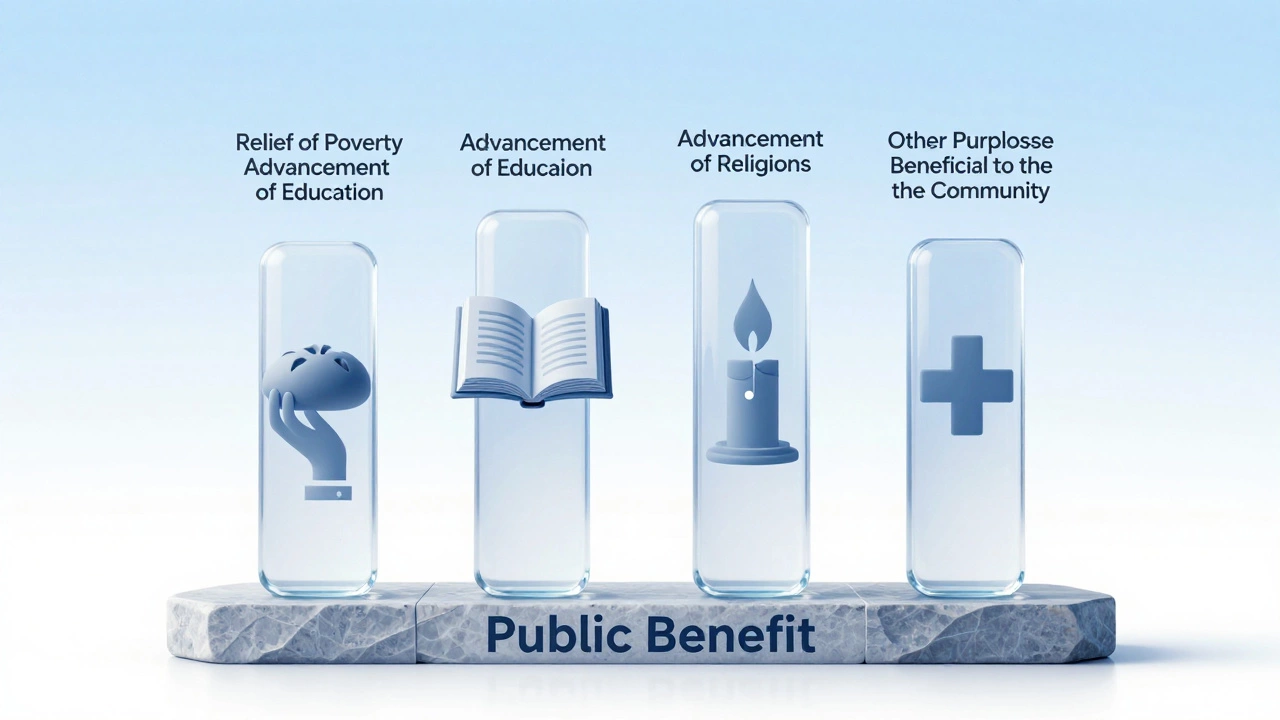
The Four Pillars of Charitable Purpose
Since you can't just pick any friend to benefit, the law restricts charitable trusts to four main categories. If your trust doesn't fit into one of these buckets, it likely isn't a valid charitable trust, and therefore, the question of who the beneficiary is becomes moot because the trust might fail entirely.
- Relief of Poverty: Providing financial aid, housing, or food to those in need. This is one of the oldest forms of charity.
- Advancement of Education: Funding schools, scholarships, libraries, or research institutions. Note that this must lead to educational improvement, not just entertainment.
- Advancement of Religion: Supporting religious organizations, places of worship, or spiritual practices.
- Other Purposes Beneficial to the Community: This is the catch-all category. It includes things like advancing health (hospitals), promoting amateur sport, protecting the environment, and improving government efficiency.
If your goal is to build a monument to your grandfather, that falls outside these pillars. It might be nice, but it’s not a charitable purpose under the law. Therefore, you cannot set it up as a charitable trust without a specific human beneficiary, which would make it a private trust instead.
The Role of the Trustee as Guardian
Without a specific beneficiary watching over their shoulder, the trustee individual or organization responsible for managing trust assets according to legal guidelines carries a heavy burden. In a private trust, the beneficiary keeps the trustee honest. In a charitable trust, the trustee must self-regulate while being subject to strict oversight by regulators.
The trustee’s job is to ensure the assets are used strictly for the stated charitable purpose. They cannot divert funds for personal use, nor can they give them to unqualified causes. For instance, if a trust is set up to fund cancer research, the trustee cannot decide halfway through that they’d rather fund a local football team. That would be a breach of duty. Courts take this very seriously because the "beneficiary"-the public-cannot easily fire the trustee.

What Happens If the Purpose Fails?
This is where the concept of cy-près comes in. In a private trust, if the beneficiary dies before getting the money, the asset goes back to the estate or to alternate beneficiaries named in the document. But in a charitable trust, since the beneficiary is the "public," the trust doesn't just vanish if the original goal becomes impossible.
Suppose you create a trust to fund a specific hospital wing, but that hospital closes down ten years later. Does the money go back to your heirs? No. Under the doctrine of cy-près (French for "as near as possible"), the court can redirect the funds to a similar charitable purpose. The money might go to another hospital or a general healthcare fund. This ensures the charitable intent survives even if the specific mechanism fails. This reinforces the idea that the true beneficiary is the charitable cause itself, not a specific project or person.
Tax Implications and Legal Status
One major reason people choose charitable trusts is tax efficiency. Because the beneficiary is the public good, governments often provide tax deductions for contributions to these trusts. In many jurisdictions, including New Zealand and the US, donating to a registered charitable trust can reduce your taxable income.
However, this benefit comes with strings attached. You must prove that the trust provides a genuine public benefit. If a regulator suspects that a trust is actually benefiting private individuals disguised as public service-for example, paying excessive salaries to trustees' relatives-they can revoke the tax status. This scrutiny exists precisely because there is no private beneficiary to complain about mismanagement.
Common Mistakes When Setting Up a Charitable Trust
Many well-meaning individuals stumble when drafting their trust deeds. Here are the most common errors:
- Naming Specific People: Trying to list individual names as beneficiaries. This invalidates the charitable status.
- Vague Purposes: Saying the trust is for "doing good." This is too broad. You must specify the charitable purpose (e.g., "relief of poverty in District X").
- Mixing Private and Charitable Interests: Creating a trust that primarily helps a few employees but claims to help the community. Regulators will pierce this veil and classify it as a private trust, losing tax benefits.
- Ignoring Perpetuity Rules: Assuming the trust can do anything forever. While charitable trusts can be perpetual, the purposes must remain charitable throughout.
Why This Matters for Your Legacy
Understanding that a charitable trust does not have a traditional beneficiary changes how you think about legacy. You aren't leaving money to a person; you are funding a mission. This shifts the focus from "who gets rich" to "what gets done." It allows your assets to work for society long after you are gone, without the complications of family disputes over inheritance.
If you want to ensure your money helps a specific person, use a private trust or a simple gift. If you want to help a cause, use a charitable trust. The law draws a bright line between the two, and crossing it can lead to legal headaches and lost tax benefits.
Can I name myself as a beneficiary of a charitable trust?
No. A charitable trust must benefit the public or a significant section of the public. Naming yourself or a small private group as the primary beneficiary disqualifies the trust from being classified as charitable. You may receive incidental benefits (like reasonable administrative fees if you are a trustee), but the primary purpose must be public benefit.
Who enforces the terms of a charitable trust if there is no beneficiary?
In the absence of specific beneficiaries, the enforcement role falls to the courts and often the Attorney General or a designated regulatory charity commission. These bodies act as guardians of the public interest to ensure trustees adhere to the trust deed and legal requirements.
What happens if the charitable purpose becomes impossible to achieve?
The doctrine of cy-près applies. The court can redirect the trust funds to a similar charitable purpose that is as close as possible to the original intent. The funds do not revert to the donor's estate unless the trust deed explicitly states otherwise and the law permits it.
Is a charitable trust the same as a non-profit organization?
Not exactly. A charitable trust is a specific legal structure holding assets for a charitable purpose. A non-profit is a broader term that can include companies limited by guarantee, societies, or trusts. All charitable trusts are non-profits, but not all non-profits are structured as trusts.
Do I need a lawyer to set up a charitable trust?
While it is technically possible to draft a simple trust deed yourself, it is highly recommended to consult a lawyer specializing in trust law. The distinction between private and charitable purposes is nuanced, and errors can lead to loss of tax status or invalidation of the trust.